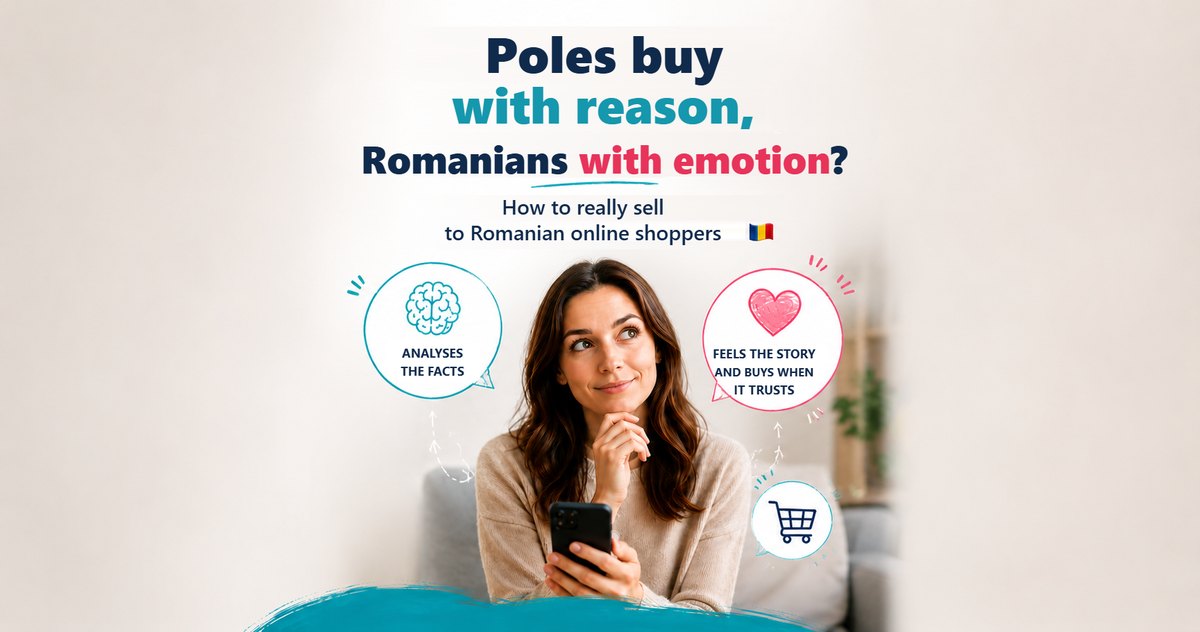
Poles buy with reason, Romanians with emotion? How to really sell to Romanian online shoppers
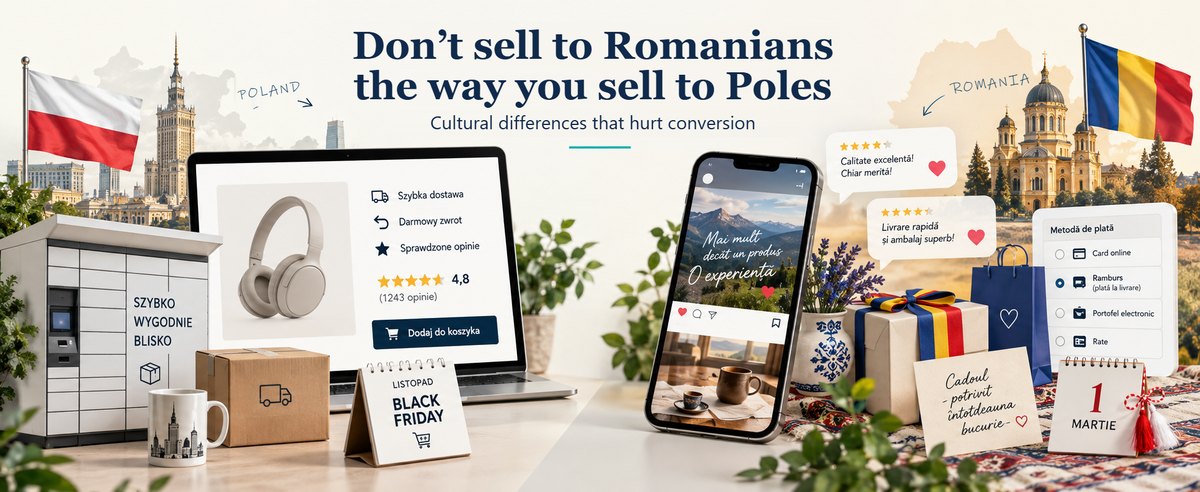
One of the biggest mistakes Polish companies make when entering Romania is assuming that because Poland and Romania are “in the same region”, shoppers will behave the same way.
They won’t.
Romania isn’t a copy of Poland in a different language. It’s a separate market, with its own shopping rhythm, its own promotion calendar, its own platforms, a different way of building trust and a completely different emotional tone in communication.
And that’s often exactly where the problem starts.
Because a Polish seller very often has a good product, a good store, a sensible price and a fair offer. And still something doesn’t click. Campaigns don’t deliver as they should. Carts get abandoned. Reviews sound different from those in Poland. Shoppers ask about things the Polish team considers obvious.
It isn’t always a product problem.
Very often it’s a problem of not understanding the local shopper.
Don’t treat Romanian shoppers as “CEE shoppers”
Central and Eastern Europe is a handy label in presentations. It gets worse when we start building a real sales strategy on it.
Poland, Romania, Czechia, Hungary or Bulgaria can be lumped together regionally, but shoppers in these markets don’t make buying decisions the same way.
What differs:
- how trust is built,
- the reaction to promotional messaging,
- expectations of contact with the store,
- attitudes to reviews,
- patience with delivery,
- the role of emotions in the buying decision.
That’s why, when entering Romania, the most important question isn’t “how do I move my Polish store to the Romanian market?”. A better question is:
how do Romanian shoppers really buy, and what do they need to trust a store?
That’s a completely different starting point.
Poles tend to analyze; Romanians tend to want to feel safe about the purchase
Of course, that’s a simplification. Not every Polish shopper is an Excel analyst, and not every Romanian shopper buys purely on emotion.
But in e-commerce practice, some differences are visible.
Polish shoppers more often describe a problem briefly and functionally. If something doesn’t fit, they’ll write something like:
“Arrived fast, wrong size.”
Short. Specific. Problem named.
In Romania, the same situation can look completely different. We had an example of a product sold in parallel by a Polish seller in both markets. In both cases, the description contained the same sizing mistake.
On the Polish marketplace, a short review appeared: fast delivery, but wrong size.
In the Romanian market, the shopper described the whole situation in roughly this tone:
“I ordered it for my sister’s birthday. The whole family came over, my sister unwrapped the gift and was really happy, and then she saw the size was wrong. She was very sad. So what am I supposed to do now?”
That’s a very important lesson.
In Poland, shoppers more often describe the mistake functionally. In Romania, shoppers may tell the whole story of the experience: the occasion, the family, the emotions, the disappointment and the social consequence.
It isn’t “being dramatic”. It’s a different way of communicating the shopping experience.
For the store, it means one thing: in Romania you don’t just sell a product. You also sell the feeling that the purchase won’t spoil an important moment for the customer.
Price matters, but it doesn’t work alone
Romanian shoppers react very strongly to price and promotions. You can see it in everyday shopping behaviour, on marketplaces, in campaigns and in the way people compare offers.
But that doesn’t mean the lowest price always wins.
A price without trust may not convert. Especially if the store is new, foreign or doesn’t show local signals of safety.
A Romanian shopper may want a deal, but at the same time asks:
- Is this store real?
- Will delivery arrive quickly?
- Can I return the product locally?
- Will someone reply if there’s a problem?
- Did other customers have a good experience?
That’s why “-20%” on its own often isn’t enough. A promotion should have context, a reason and an emotional justification.
It’s not about writing a poem for every markdown. It’s about not leaving the discount hanging in a vacuum.
The language of emotion versus the language of specs
Polish e-commerce very often speaks in specs.
Size. Weight. Material. Number of pieces. Product code. Promotion. Delivery.
All of that is needed. But in Romania the language of specs alone often isn’t enough, especially in lifestyle, beauty, home, fashion, kids, wellness or gift categories.
Romanian shoppers respond better to language that shows:
- the situation of use,
- the benefit in everyday life,
- emotion,
- relationships,
- comfort,
- the effect for the buyer or the person receiving the gift.
In other words: not just “what is it?”, but also “what do I need it for?”, “when will I use it?”, “how will I feel with it?”, “what problem does it solve?”.
That doesn’t mean the description should be sugary. It means it should be written in natural, sales-oriented Romanian that sounds local, not like a translation from a Polish catalog.
In Romania, a good description often doesn’t just sell a product. It sells a scenario.
The product gallery speaks too. In Romania, treat it as part of the description
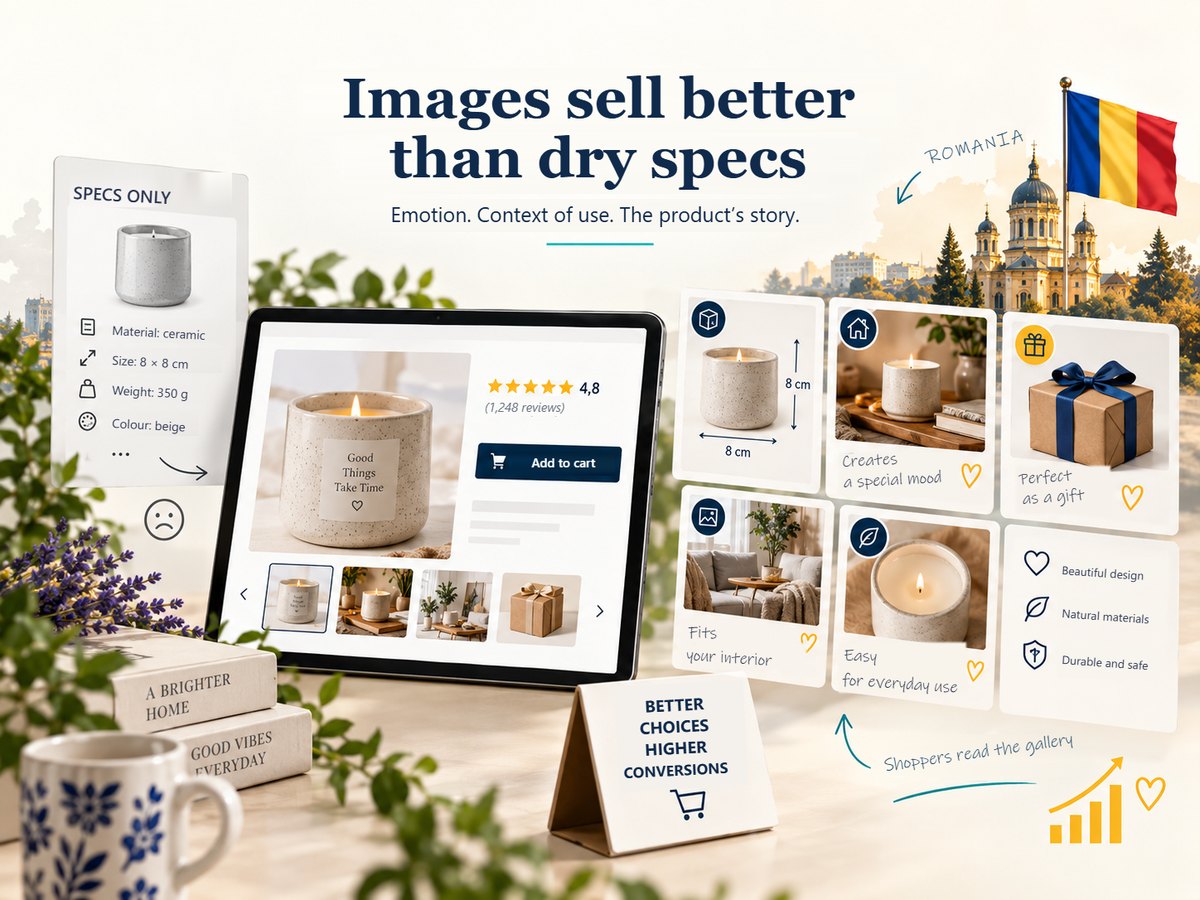
In Romania, shoppers often don’t just look at product photos. They read them.
That means the gallery shouldn’t be just a set of packshots on a white background. Those photos are needed, of course, but if your visual communication stops there, you leave a lot of room to competitors.
Romanian shoppers respond well to images that help them quickly understand:
- how big the product is,
- what it’s for,
- in what situation they’ll use it,
- what its main benefits are,
- what sets it apart,
- why it’s worth buying right now.
So it’s worth investing in images that sell, not just show the product.
What does that mean in practice? Product galleries work well with:
- pictograms with dimensions,
- short benefit messages,
- infographics showing how the product is used,
- lifestyle photos showing real use,
- variant comparisons,
- icons with added value,
- simple messages like “easy assembly”, “perfect gift”, “for everyday use”, “compact size”, adapted to the category, of course.
In many categories, shoppers won’t read the whole description straight away. First they swipe through the gallery. And that’s exactly where you can answer their first questions.
In Romanian e-commerce, a good photo doesn’t just show the product. A good photo guides the shopper through the buying decision.
So if your gallery is “good enough” in Poland, in Romania it’s worth asking an extra question: do my photos explain the product as well as a salesperson in a store would?
Reviews and social proof are more narrative
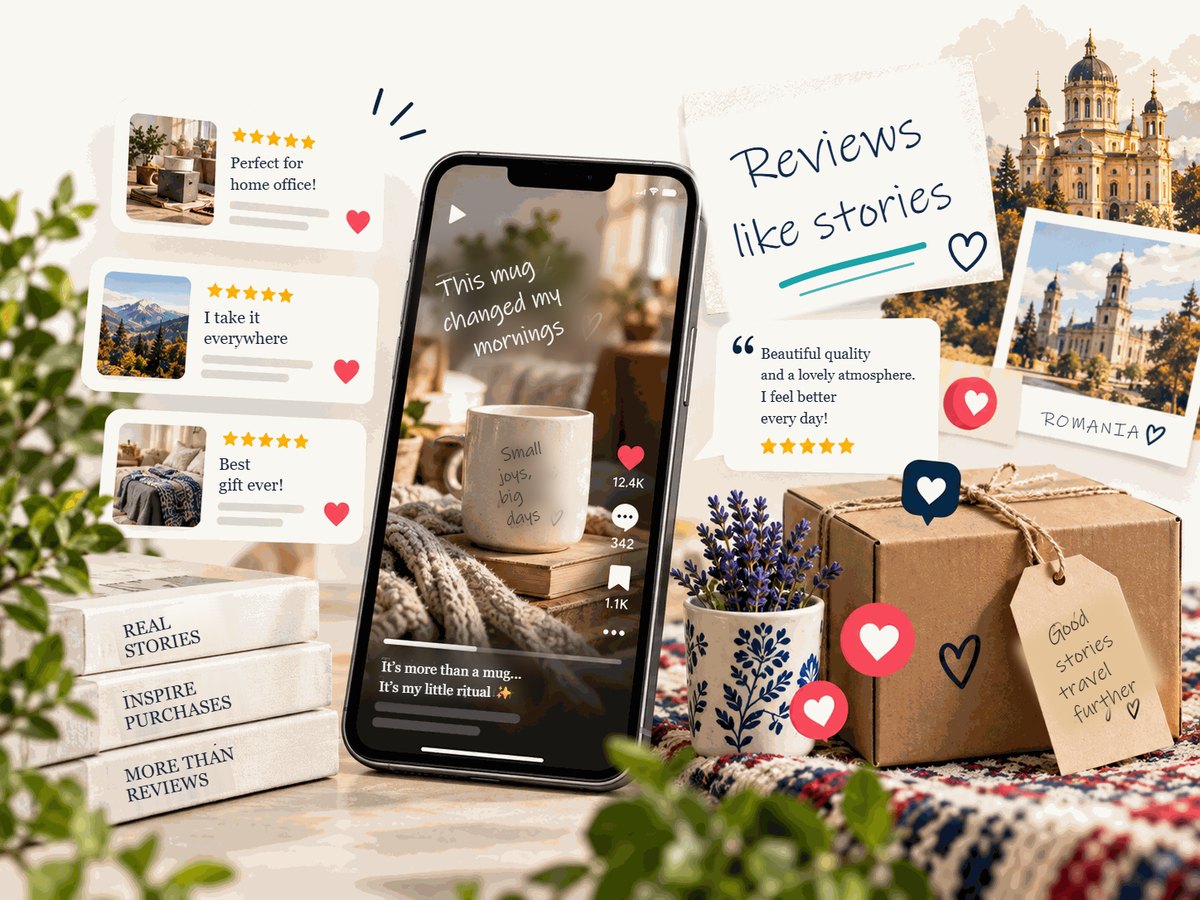
In Romania reviews matter enormously, but not only the average rating.
Of course, stars are important. So is the number of reviews. But Romanian shoppers very often read reviews like mini-stories. They look for confirmation that someone had a real experience, a real problem, a real emotion and a real solution.
That’s why it’s worth highlighting not just bare ratings, but also:
- reviews with longer descriptions,
- customer photos,
- replies from the store,
- comments about delivery,
- the context in which the product is used,
- post-purchase experiences.
Social proof in Romania should be more human than spreadsheet-like.
If shoppers see only “4.8/5”, that’s fine. But if they see someone describing why the product worked, how fast it arrived, what contact was like and whether the purchase met expectations, it builds a much stronger sense of safety.
And safety in Romanian e-commerce isn’t a detail. It’s one of the foundations of conversion.
Social media as a source of information, emotion and buying impulse
Romanians are very attached to their phones. The smartphone is the main screen for information, entertainment and shopping.
And when it comes to social media, TikTok can’t be ignored.
TikTok has captured a great deal of users’ attention in Romania. For many categories it’s no longer just a “reach” channel but a real part of the path to purchase. Shoppers see a product, react emotionally, check the comments, look for reviews, compare the price and only then decide.
Products suited to impulse shopping can work especially well here:
- beauty,
- fashion,
- accessories,
- home,
- gadgets,
- lifestyle products,
- problem-solution products,
- gifts,
- small products with a strong “I need this” effect.
In Romania it’s worth investing in TikTok promotion, short video and influencer collaborations. It isn’t always about big names. Creators who are well matched to the category and target group often work better.
On top of that, Romania has a very well-developed local platform for working with influencers: MOCAPP. It can help you find creators who fit your category, budget and campaign goal, instead of searching for them by hand on Instagram or TikTok.
If your product can be shown in 15 seconds and triggers an “oh, I need this” reaction, Romania is a market where social media can do a lot for it.
Checkout: Poles want to choose, Romanians want to decide quickly
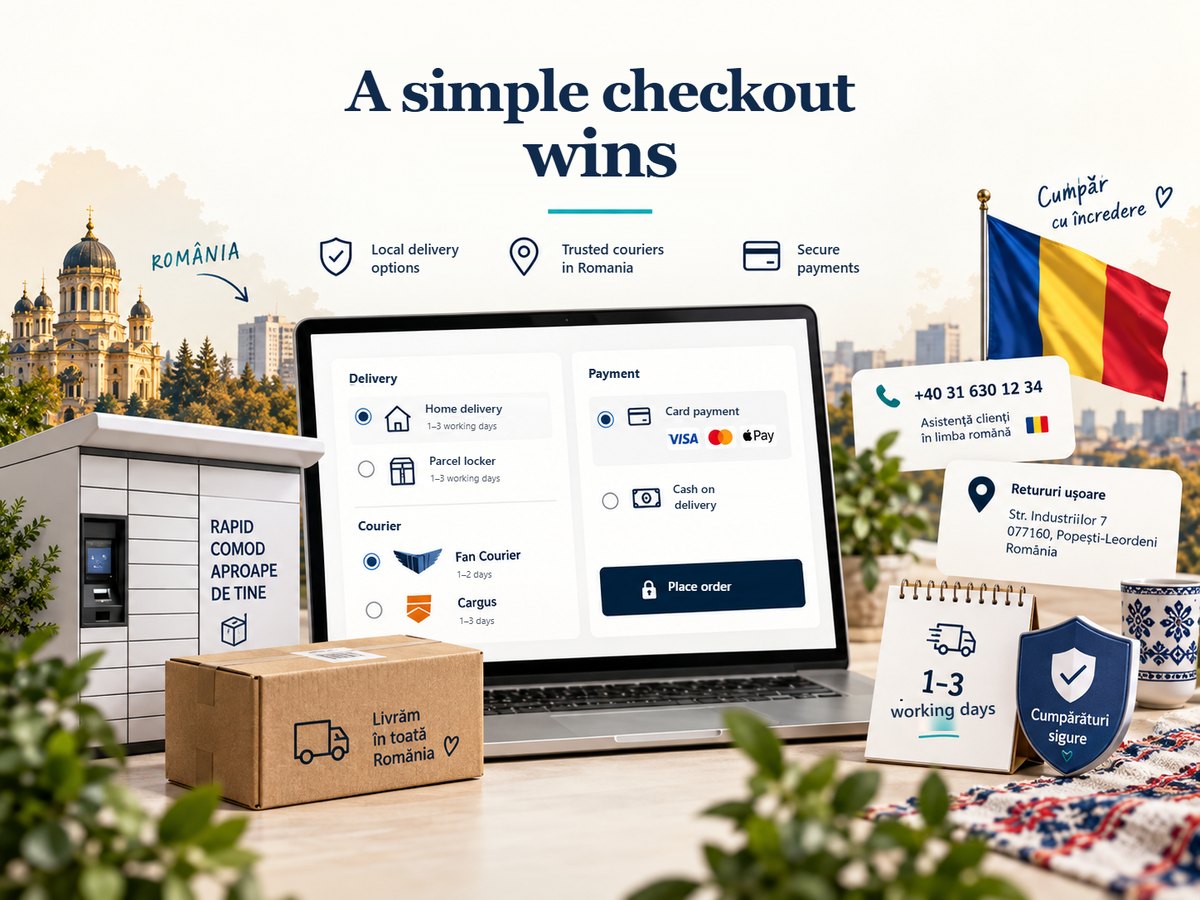
This is a very practical difference.
In Poland, many stores compete with a wide choice of delivery methods, pickup points, couriers and payment options. For Polish shoppers, lots of choice is often an advantage.
In Romania, too long a list of options at checkout can have the opposite effect.
Romanian shoppers often respond better to a simpler, trimmed-down path:
- home delivery,
- parcel locker,
- one, or at most two, locally recognized couriers.
You don’t need to show the full list of possible carriers. Too many options can create friction rather than a sense of control.
This matters a lot when designing the cart. Localizing a store isn’t just about language, currency and terms. It’s also about how you guide the shopper through the decision.
In Romania, a checkout that says “pick one of two clear options” often works better than one that tries to impress with the number of possibilities.
Local presence as a signal of safety
You don’t need an office in Romania straight away.
But shoppers need to feel they can reach you.
In practice, local safety signals make a big difference:
- a Romanian phone number,
- a local-sounding email address,
- a Romanian returns address,
- a native speaker for communication,
- clear information about delivery and returns.
A Romanian returns address has huge psychological weight. Shoppers don’t want to wonder whether, if something goes wrong, they’ll have to send the parcel to Poland, how long it will take and whether they’ll get their money back.
A Romanian phone number works the same way. Even if the shopper never calls, its presence alone builds trust.
This is where outsourcing really helps. A local logistics partner, a returns address, a native speaker for communication or external operational support can give shoppers a local service experience without you having to open an office in Romania.
It’s also worth remembering that, thanks to eMAG, shoppers have got used to very fast deliveries, including at weekends. If your own store wants to compete for trust, it has to communicate delivery times very clearly and can’t pretend shoppers won’t notice the difference between the local standard and shipping “sometime from Poland”.
Promotion messaging: the Romanian calendar isn’t the Polish calendar
Another mistake that looks innocent.
A Polish company plans its campaigns by the Polish calendar, then wonders why the messaging doesn’t quite hit the local shopping rhythm.
Romania’s marketing calendar has its own logic.
First example: in Romania, the first day of spring starts, culturally and in communication, on 1 March with Mărțișor, not on 21 March. It’s an important moment for gifts, beauty, fashion, lifestyle and products that can be communicated through a gesture, a symbol, a new season or femininity.
Second example: the unofficial start of summer can be taken as 1 June, Children’s Day. It’s a good moment for family, kids, outdoor, holiday, lifestyle and gift campaigns.
Third example: Black Friday.
In Romania, Black Friday has its own dynamics. The date is announced every year by eMAG at Sellers Days and is usually earlier than the classic Black Friday known in Poland or the US. That means preparation has to start much earlier: prices, feeds, stock, logistics, creatives, marketplaces, campaigns, newsletters.
On top of that, most platforms in Romania treat practically the whole of November as Black Friday. Locally, nobody is surprised when Halloween promotions roll smoothly into Black Friday and then almost immediately into St Nicholas’ Day and December gift shopping.
If you plan Black Friday in Romania by the Polish calendar, it’s quite possible that while you’re still finalizing the brief, local competitors have been warming up their campaigns and warehouses for weeks.
Romanian shoppers aren’t harder. They’re simply different
This is the most important conclusion.
It’s not about saying Polish shoppers are rational and Romanian shoppers emotional. That would be too simple.
It’s about the fact that buying decisions are rooted in culture, language, habits, expectations and experience with local platforms.
Romanian shoppers:
- need local signals of safety,
- react strongly to emotion and context,
- read reviews as stories,
- “read” the product gallery before moving on to the full description,
- love promotions but want to trust them,
- spend a lot of time on social media,
- are used to fast deliveries,
- expect a simple checkout,
- and follow the local shopping calendar.
That’s why expansion into Romania shouldn’t start with the question “how do we translate the store?”. It should start with the question:
how do Romanian shoppers make buying decisions?
Only then is it worth building the store, campaigns, content, marketplaces and operations.
Because well-prepared e-commerce for Romania isn’t a Polish store in Romanian. It’s a shopping experience designed for Romanian shoppers.
Check your products’ potential
We’ll assess whether your products can succeed in Romania or Poland: demand, competition, prices, and delivery and return costs. We’ll also suggest which channel to start with.