Only know eMAG? How skipping other Romanian marketplaces costs you profit, part 1
If your strategy for entering Romania is “we’ll put it on eMAG and see what happens”, you’re in a fairly large club. The problem is that it isn’t always the most profitable one.
Because yes, eMAG is huge. Yes, it’s worth starting there. And yes, in many cases it’s the logical first step. But if you stop at eMAG, you may well be leaving money on the table.
It’s a bit like coming to Bucharest, eating one bowl of ciorbă and going home convinced you know all of Romanian cuisine.
You don’t.
I’ve lived in Bucharest for 12 years and have worked for years where Polish and Romanian e-commerce meet. I’ve had the chance to see this market from several sides, including from inside big players. That’s exactly why I’ll say it plainly: in Romania, the winner isn’t whoever “is on a marketplace”. It’s whoever is on the right marketplaces for their category.
Romania isn’t just eMAG
This is one of the most common mental shortcuts among foreign sellers.
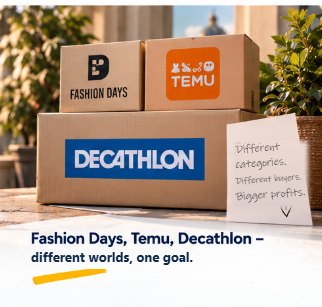
You hear “marketplace Romania” and immediately think “eMAG”. End of discussion. Yet the Romanian marketplace landscape has become much more interesting. Besides eMAG, these also matter a great deal:
- Altex
- Trendyol
- Fashion Days
- Temu
- Decathlon
Each of these channels has a slightly different customer, a different buying logic and a different role for different categories. And that’s where real strategy begins.
Why does it matter at all?
Because Romania is no longer “a small test market”.
It’s a market that keeps growing, and e-commerce’s share of shopping and everyday consumer habits is steadily increasing. On top of that, Romanian shoppers:
- react very strongly to price,
- love promotions,
- are increasingly comfortable buying cross-border,
- compare platforms and experiences,
- don’t have any particular sympathy for the fact that you’re only testing the market.
They simply buy where it’s most convenient for them.
Which means that if you’re not in the right place, you don’t lose “a little”. Someone else simply sells instead of you.
If you’re writing Romanian descriptions for eMAG anyway, why not use them more widely?
This is the point many sellers make unnecessarily complicated.
Because if you’re already preparing your offer for eMAG, meaning you’re creating:
- titles in Romanian,
- descriptions,
- specs,
- photos,
- localized content,
then you’ve already done a big part of the work needed to enter other Romanian marketplaces too.
From a product content point of view, very little stops you from using the same descriptions more widely instead of locking them into one platform.
In practice, the biggest challenge usually isn’t the listings. The hard part comes later:
- choosing logistics that can handle sales from several channels,
- implementing an OMS/WMS with integrations for these marketplaces,
- keeping stock, orders and shipments under control without operational chaos.
Altex: if you sell electronics, don’t stop at eMAG

If you’re in electronics, small appliances, tech accessories, smart home or tech-lifestyle in the broad sense, Altex should be on your radar very early.
It’s a marketplace that grew out of a very strong electronics and appliances retail chain. That means one important thing: shoppers don’t end up there by accident. They arrive with a clear buying intent.
On eMAG, shoppers look for everything.
On Altex, they more often look for electronics, appliances and categories that naturally fit the platform in their minds.
What’s worth selling there?
The most natural fits are:
- consumer electronics,
- small appliances,
- mobile and IT accessories,
- smart home,
- gaming accessories,
- TV and selected technical home accessories.
Who does Altex make sense for?
Not everyone. It’s more of a channel for:
- larger sellers,
- manufacturers,
- companies with a solid catalog,
- brands that have their feed and operations under control.
It’s also worth remembering that Altex has a previous-year turnover threshold that determines who can sell there. So before you plan your entry, check whether your company meets their expectations.
A practical tip
If your product is technical, functional and fits a retail-electronics mindset, Altex can give you a better sales context than a broad general marketplace.
Trendyol: a channel many still underestimate

Trendyol is one of those marketplaces some sellers still look down on a bit. And then it turns out their competitors are building very nice volumes exactly there.
It’s a particularly interesting platform for categories such as:
- fashion,
- accessories,
- beauty,
- home accessories,
- household cleaning products,
- small lifestyle items,
- promo-driven and value-driven products.
What’s interesting about it?
First, Trendyol understands the promotional shopper very well: fast, mobile and looking for a deal.
Second, and very practically, it’s quite open to launching new categories. If you don’t see your category in the system, it’s often enough to open a ticket. The team gladly passes the request to legal, and a new category can be launched in a relatively short time.
So the classic “there’s no category, so it can’t be done” often turns out to be simply too quick an assumption.
AI and listings
It’s also one of the more advanced marketplaces when it comes to AI solutions. In practice, to create listings it’s often enough to send the product link from eMAG, and the system can copy it and speed up listing preparation. Another argument that entering a new channel doesn’t have to mean starting from zero.
What does promotion look like?
On Trendyol, a large part of promotion is built on ready-made influencer packages. That matters, because it shows the platform doesn’t live on feeds and listings alone but also relies heavily on ready-made promotional mechanisms.
Who does it make sense for?
If you have a product that:
- looks good,
- responds well to promotions,
- doesn’t need much explaining,
- makes sense at higher volumes,
then Trendyol can be a very good second or third step after eMAG.
Fashion Days: better context for fashion than a general marketplace
If you sell fashion, footwear, accessories, sport fashion or lifestyle beauty, it’s worth taking Fashion Days much more seriously than many foreign sellers do.
Why? Because the shopping context changes here.
On eMAG, your fashion product sits next to a blender, a child car seat and dog food. On Fashion Days, shoppers are in a completely different mode. More inspired, more aesthetic, more focused on fashion.
What’s worth selling there?
Most naturally:
- clothing,
- footwear,
- accessories,
- handbags,
- fashion accessories,
- sport fashion,
- selected beauty.
What should you prepare in addition?
With Fashion Days it helps to have not only listings but also an extra presentation about your company and the products you plan to sell. It helps show your brand better, organize your offer and makes the conversation with the platform easier.
A practical tip
Here, more than anywhere else, what counts is:
- good content,
- photos,
- a size chart,
- a consistent brand presentation,
- and solid materials about the company.
In Romania, fashion without good content usually doesn’t fail loudly. It simply goes unnoticed.
Temu: even if you don’t want to sell there, you need to understand its impact
Temu is a topic that can no longer be swept under the rug.
It’s not just about whether you want to sell there. It’s that Temu is already changing what Romanian shoppers expect.
It affects how shoppers look at:
- price,
- promotions,
- bundles,
- the appeal of cross-border shopping,
- and the general sense of “is this worth it”.
Which categories are especially strong there?
Most often:
- home,
- accessories,
- small everyday items,
- fashion accessories,
- gadgets,
- value beauty tools,
- impulse purchases.
A very important note
With Temu, you need to prepare your accounting very carefully to settle these sales correctly. It’s one of the areas many sellers simply set up wrong. Then the problem isn’t the sales themselves but a back office that wasn’t ready to account for this model properly.
Is it worth getting in?
It depends on your category, margin and business model. For very price-driven, mass-market products it can make sense. For premium brands or products that need explaining, understanding Temu’s impact on your category is often more important than actually joining the platform.
The biggest mistake today isn’t “not being on Temu”. The biggest mistake is pretending Temu doesn’t exist.
Decathlon: if you’re already on the Polish version, you have an easier start
Decathlon Marketplace is a very interesting option for:
- sport,
- fitness,
- outdoor,
- travel,
- cycling,
- camping,
- active lifestyle,
- and some rehabilitation products with a strong sports context.
It’s one of the best examples of a specialized marketplace beating the biggest general one.
Why?
Because on Decathlon, shoppers are already “in sport mode”. They aren’t looking for everything. They’re looking for products for activity, training, trips and movement. That means your product reaches them at a much better moment of buying intent.
The good news
If you’re already on the Polish version of Decathlon Marketplace, copying your sales setup in your account to Romania is relatively easy. Very good news for brands already working in this ecosystem that don’t want to build everything from scratch.
When does this channel make sense?
When you really sell a category rooted in sport, outdoor or active lifestyle. In that environment it’s much easier to:
- build logical positioning,
- sell complementary products,
- and not get lost in the chaos of a broad marketplace.
So where to sell after eMAG?
It depends on your category, margin, operational maturity and how seriously, rather than symbolically, you want to expand.
But to simplify:
After eMAG, it’s usually worth considering:
- Altex if you’re in electronics, appliances or tech,
- Trendyol if you’re in fashion, value, home accessories and promo-driven categories,
- Fashion Days if you have fashion or a product that needs better context,
- Temu if your category really competes on price, or if you at least need to understand its impact on the market,
- Decathlon if you’re in sport and outdoor.
The biggest mistake? Copying your home market 1:1
It’s a classic.
A foreign seller takes their model from home and assumes:
- the same descriptions,
- the same prices,
- the same feed,
- the same channels,
- the same assumptions.
And then they’re surprised that Romania doesn’t react the same way.
Meanwhile, Romanian shoppers:
- are more price-focused,
- react more strongly to promotions,
- compare platforms faster,
- are increasingly open to cross-border shopping,
- and have their own marketplace habits.
Romania is close to Poland, but it isn’t a copy of Poland.
Summary
I have nothing against eMAG. Quite the opposite. I just have a lot against strategies that go: “we’ll do eMAG and we’ll be present in Romania”.
No. You’ll be present on one channel.
And being present on one channel isn’t an expansion strategy. It’s more of a patience test.
If you want to really make money in Romania, you have to look wider:
- where shoppers look for your category,
- where your product has the best context,
- where the margin makes sense,
- where your brand doesn’t get lost in the crowd,
- and how to tie it all together operationally, since you’re already doing the work for eMAG anyway.
Because in Romania money often doesn’t slip away because the market is hard. It slips away because the seller looks too narrowly.

Check your products’ potential
We’ll assess whether your products can succeed in Romania or Poland: demand, competition, prices, and delivery and return costs. We’ll also suggest which channel to start with.